Why Generative Engine Optimization (GEO) is Every Entrepreneur's Next Frontier
As one Forbes article notes, when an AI like ChatGPT suggests your product, it serves as a powerful signal of your expertise, creating a strong loop of credibility.


For decades, entrepreneurs have mastered the art of Search Engine Optimization (SEO), battling for coveted top spots on Google. But the rise of generative AI is rewriting the rules of discovery.
We are moving from an era of clicks to an era of citations, and a new discipline has emerged as the key to visibility: Generative Engine Optimization (GEO).
For entrepreneurs, understanding and mastering GEO is not just an option; it is the next frontier for growth, authority, and even business valuation.
For years, the goal was simple: rank high, get the click, and drive traffic. Now, with AI-powered platforms like ChatGPT, Perplexity, and Google's own AI Overviews answering questions directly, the user journey is changing. Instead of a list of links, users receive synthesized answers, with AI engines citing the sources they deem most credible.
If your business isn't one of those cited sources, you risk becoming invisible to a rapidly growing segment of your potential market. This article explores the fundamentals of GEO, its critical importance for entrepreneurs, and provides an actionable roadmap to navigate this new terrain.
What is Generative Engine Optimization (GEO)?
Generative Engine Optimization (GEO) is the practice of strategically creating and structuring digital content to be discovered, understood, and cited by AI-powered answer engines. [1] [2] Unlike traditional SEO, which focuses on ranking a webpage in a list of search results, GEO aims to have your brand's information and expertise directly integrated into the AI-generated response. It is about becoming a trusted source for the AI itself.
This new field is also referred to by several other names, including Answer Engine Optimization (AEO), Artificial Intelligence Optimization (AIO), and Large Language Model Optimization (LLMO). [1]
At its core, it acknowledges that AI systems, often using Retrieval-Augmented Generation (RAG) frameworks, are actively scanning, indexing, and retrieving information to construct their answers. GEO is the art and science of ensuring your content is primed for that retrieval process.
The Paradigm Shift: From SEO to GEO
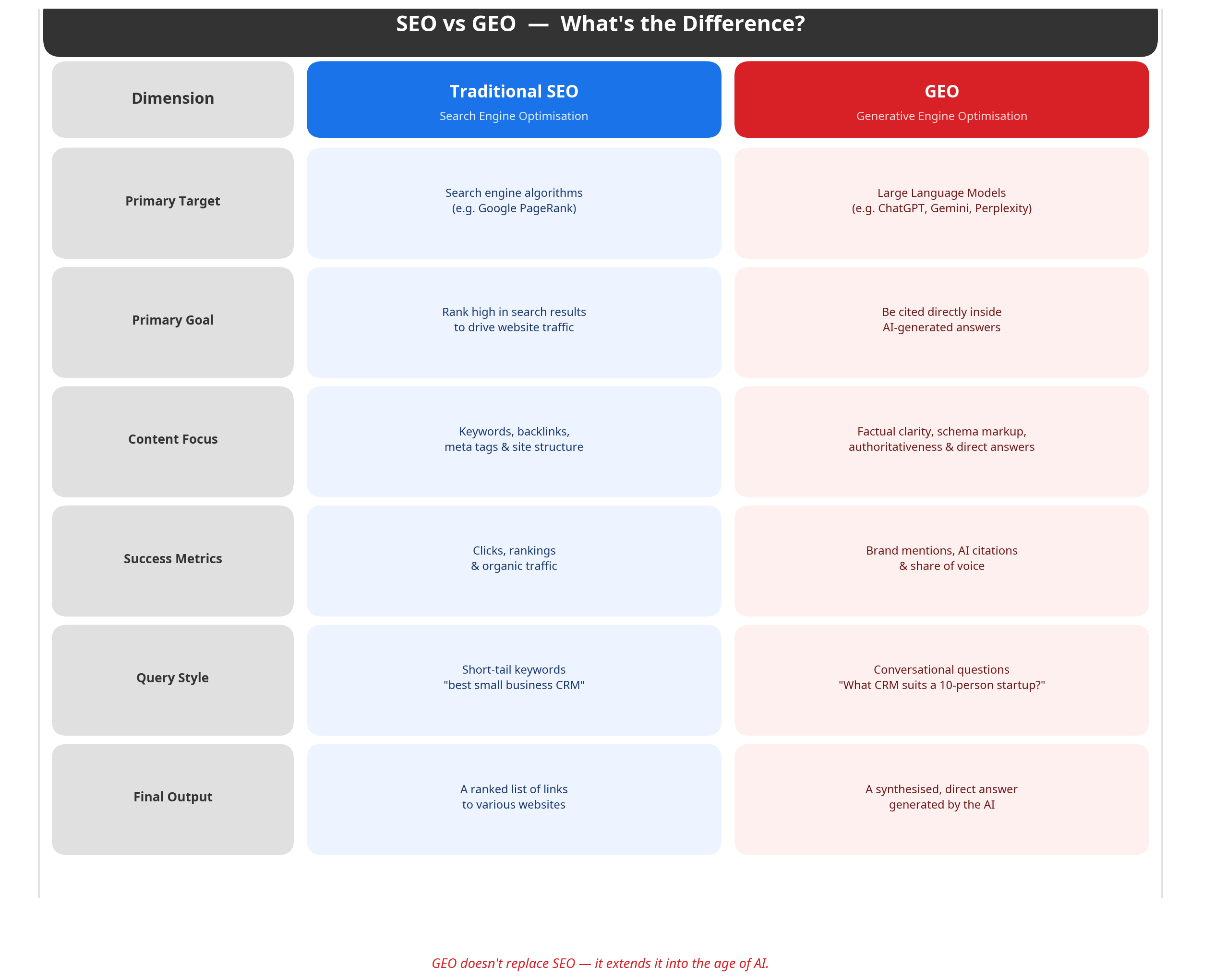
The transition from an SEO-centric to a GEO-aware strategy represents a fundamental change in how we approach digital content. While the two are not mutually exclusive and share foundational principles of quality and authority, their objectives and tactics differ significantly. Understanding these differences is the first step for any entrepreneur looking to adapt.
Why GEO is a Non-Negotiable for Entrepreneurs
The rise of AI search is not a distant trend; it is a present-day reality with profound implications. A 2025 report from McKinsey highlights that about half of consumers already use AI-powered search, with a staggering prediction that $750 billion in revenue will flow through AI search by 2028. [3] The same report warns that brands unprepared for this shift could see a 20% to 50% decline in traffic from traditional search channels. For entrepreneurs, embracing GEO is a strategic imperative for several key reasons.
"When 84% of decision-makers are already buying based on AI's first suggestion, visibility in AI results isn't optional anymore." — Curtis Sparrer, Principal, Bospar PR [4]
The First-Mover Advantage
In this nascent field, there is a significant opportunity for early adopters. By optimizing for GEO now, entrepreneurs can establish their businesses as the foundational, authoritative sources that AI models learn from and continue to cite. As competitors play catch-up, early movers will have built a defensible moat of credibility within the AI ecosystem, creating a powerful and lasting competitive advantage.
Building Unshakeable Brand Authority
Being cited by an AI engine is a powerful, third-party endorsement. It positions your brand not just as a service provider, but as a definitive source of expertise. This digital word-of-mouth builds immense trust and authority with potential customers.
As one Forbes article notes, when an AI like ChatGPT suggests your product, it serves as a powerful signal of your expertise, creating a strong loop of credibility. [5]
A New Metric for Investors and Acquirers
Beyond customer acquisition, GEO is becoming a tangible business metric that signals market relevance and narrative strength. As noted by Entrepreneur.com, strong GEO visibility can enhance a company's exit potential and support its valuation by amplifying its perceived market relevance. [6]
For founders seeking investment or planning an exit, demonstrating dominant visibility in AI-driven conversations is a powerful new way to showcase brand equity and category leadership.
An Entrepreneur's Actionable GEO Checklist
Transitioning to a GEO-focused strategy does not require abandoning SEO. In fact, strong SEO fundamentals are the bedrock of good GEO. The following strategies build upon that foundation to optimize for the age of AI.
- Answer Real Questions Directly: Identify the most common questions your customers ask and create dedicated, in-depth content that answers them thoroughly. Research shows that a significant portion of AI citations are pulled from the introductory sections of an article, so providing clear, direct answers upfront is crucial. [7]
- Embrace Structured Data: Implement schema markup on your website. This is a form of microdata that acts as a behind-the-scenes label, telling AI engines exactly what your content is about (e.g., an FAQ page, a how-to guide, product specifications, or business hours). This removes ambiguity and helps AI interpret your information correctly.
- Build Multi-Platform Authority: AI models prioritize information from sources they deem trustworthy. This means your authority is not just built on your own website. Earn mentions on reputable third-party sites through guest posts, podcast appearances, and strategic digital PR. Research indicates that brands are 6.5 times more likely to be cited through third-party sources than their own domains. [7]
- Optimize for Natural Language: Shift your content focus from short keywords to answering conversational, long-form questions. Think about how a person would verbally ask an AI assistant for information and structure your content, especially headings and FAQ sections, to match that natural language.
- Keep Content Fresh and Factual: AI tools have a strong preference for recent, updated information. Regularly refresh your core content with current data, statistics, and dates. Ensure all claims are factually accurate and, where possible, supported by citations to other authoritative sources.
- Track Your "Mention Share": The currency of GEO is not clicks, but citations. Begin tracking how often your brand is mentioned in AI responses for key industry queries. New tools and services are emerging that can audit your AI visibility and provide competitive benchmarking.
The Risks and Realities of the New Frontier
While the opportunity is immense, entrepreneurs must also navigate the risks of this new landscape. AI models are not infallible; they can "hallucinate" incorrect information or even cite links that lead to error pages. [7]
Furthermore, AI-generated results can be highly volatile and inconsistent, with one study finding that Google's AI Mode had overlapping results with itself just 9.2% of the time across repeated tests. [7] Therefore, a balanced approach is essential.
Do not abandon proven SEO practices. Instead, integrate GEO as a complementary strategy that prepares your business for the future of search without sacrificing the stability of the present.
Conclusion: Securing Your Place in the Answer
The way customers discover businesses is fundamentally changing. The journey is no longer just about finding information, but about getting answers. Generative Engine Optimization is the strategic imperative that ensures your business is an integral part of those answers.
By focusing on creating clear, authoritative, and well-structured content, entrepreneurs can not only maintain their visibility but also build a new kind of brand equity in the age of AI.
The entrepreneurs that adapt quickly will secure their connection to the customers of tomorrow, while those who ignore this shift risk being left out of the conversation entirely.
As always...if you need any support on your content or AI strategy feel free to reach out.


References
[1] Generative engine optimization. (2026, February 18). In Wikipedia.
[2] What is Generative Engine Optimization (GEO)? (2025, November 4). Conductor.
[3] New front door to the internet: Winning in the age of AI search. (2025, October 16). McKinsey & Company.
[4] How to Improve Small Business AI Search Visibility with GEO. (2025, December 10). U.S. Chamber of Commerce.
[5] Generative Engine Optimization: The Next Frontier In SEO. (2025, October 23). Forbes Agency Council.
[6] Why Brand Mentions in AI Are Becoming a Business Metric. (2025, December 8). Entrepreneur.
[7] 100+ AI SEO Statistics for 2026 (Updated February). (2026, February 17). Position Digital.