What can we learn from the Olympics about using AI for audience engagement?
The Winter Olympics have always been a showcase for human performance. But at the Milano Cortina 2026 Games, they are also becoming a showcase for something else: the growing role of artificial intelligence in helping audiences understand what they’re watching.


Fascinated by the real time replays, and the amazing graphics at the Olympics? I have been. But I also am interested in how these new techniques can be applied to business.
The Winter Olympics have always been a showcase for human performance. But at the Milano Cortina 2026 Games, they are also becoming a showcase for something else: the growing role of artificial intelligence in helping audiences understand what they’re watching.
360-degree visualisations
Olympic Broadcasting Services (OBS), the organisation responsible for delivering the live pictures to broadcasters worldwide, has introduced a new generation of AI-assisted replay systems. These allow producers to generate full 360-degree visualisations of key moments in as little as five seconds — a process that previously could take hours, or even days.
The technology works by combining feeds from hundreds of cameras with AI models that separate athletes from their surroundings. This allows producers to “freeze” a moment and move the viewer’s perspective around it, revealing angles and details that would otherwise be impossible to see in real time.
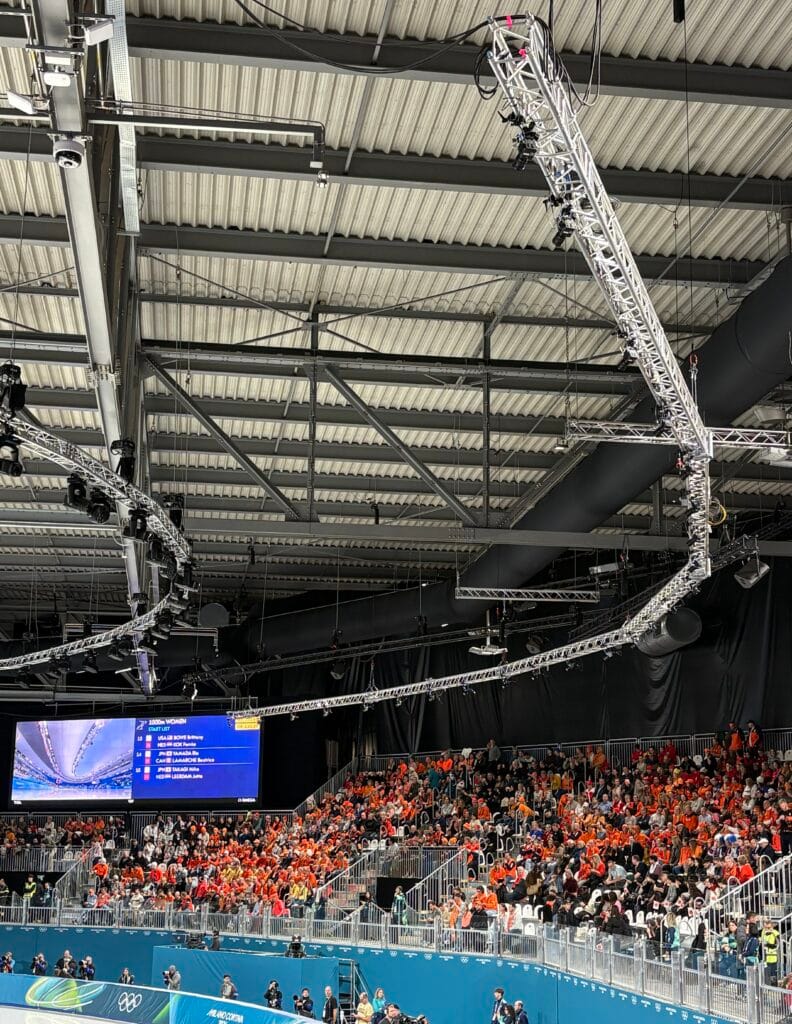
It’s not the first time multi-angle replays have been used in sport, but the speed and consistency of this new system mark a step change. At Milano Cortina, more than 450 cameras and 17 dedicated 360-degree capture systems are being used across events including figure skating, ski jumping, ice hockey and speed skating.
The aim is not simply visual spectacle. According to OBS, the primary purpose is explanation.
Winter Olympic sports are highly technical, and many viewers encounter them only once every four years. By allowing commentators to pause, rotate and analyse movements moments after they happen, the technology helps explain the skill, timing and physical precision involved.
Under the Hammer

Curling provides a good example. Traditionally, much of its strategy has been invisible to casual viewers. Now, AI-based tracking systems follow each stone’s exact path, speed and rotation, displaying this information live. Combined with overhead camera systems, this makes it possible to see not just where a stone ends up, but how and why it got there.
“In curling, later in the competition, we will be using AI to explain a little bit better what’s going on with sweeping of the ice and the spin of the stones, things that we couldn’t do until now on a live basis,”
said OBS chief executive Yiannis Exarchos.
“You previously needed to do them post-event, but now with AI it is starting to be possible to follow this live and show people exactly how it works.”
In practical terms, this brings audiences closer to the decision-making and technique that define elite sport.
Taken together, these developments point to a broader shift in sports broadcasting. For decades, improvements focused largely on image quality — from colour television to high definition to ultra-high definition.
The current phase is less about resolution and more about interpretation.
In other words, it’s no longer just about showing events more clearly, but about helping audiences understand them more deeply.
For viewers, this may make complex sports more accessible and engaging. For broadcasters, it opens new possibilities for storytelling. And for the Olympic movement, it reflects an ongoing effort to connect global audiences with sports that may be unfamiliar to them.
What this means for business
The relevance to business is striking. Most organisations do not struggle because they lack capability, but because the value of what they do is not fully understood by their customers.
Traditionally, clients have seen only the outcome — the successful campaign, the improved performance, the finished project — without visibility into the thinking and process behind it.
AI-enabled tools are beginning to change this by making process more visible. Marketing teams can now demonstrate how campaigns evolve over time, sales leaders can track and illustrate how prospects move through a pipeline, and consultants can show the progression of analysis and decision-making.
This visibility builds confidence, because clients are able to see not just the result, but the method that produced it.
Speed is equally important. Just as Olympic broadcasters can now generate detailed replays within seconds, businesses are increasingly able to access and share insight almost immediately.
Live dashboards, real-time analytics and automated reporting allow organisations to explain performance while it is happening, rather than long after the fact.
This shortens the gap between action and understanding. It also makes complex work easier to appreciate. In fields such as law, engineering, coaching and marketing, much of the expertise lies in judgement, sequencing and interpretation — elements that have historically been difficult to demonstrate.
AI does not replace that expertise, but it can help surface it, turning what was once opaque into something clearer and more accessible.