The Publishing Engine: Mastering the Art of Distribution
Customers need to know they can rely on you before they buy from you.

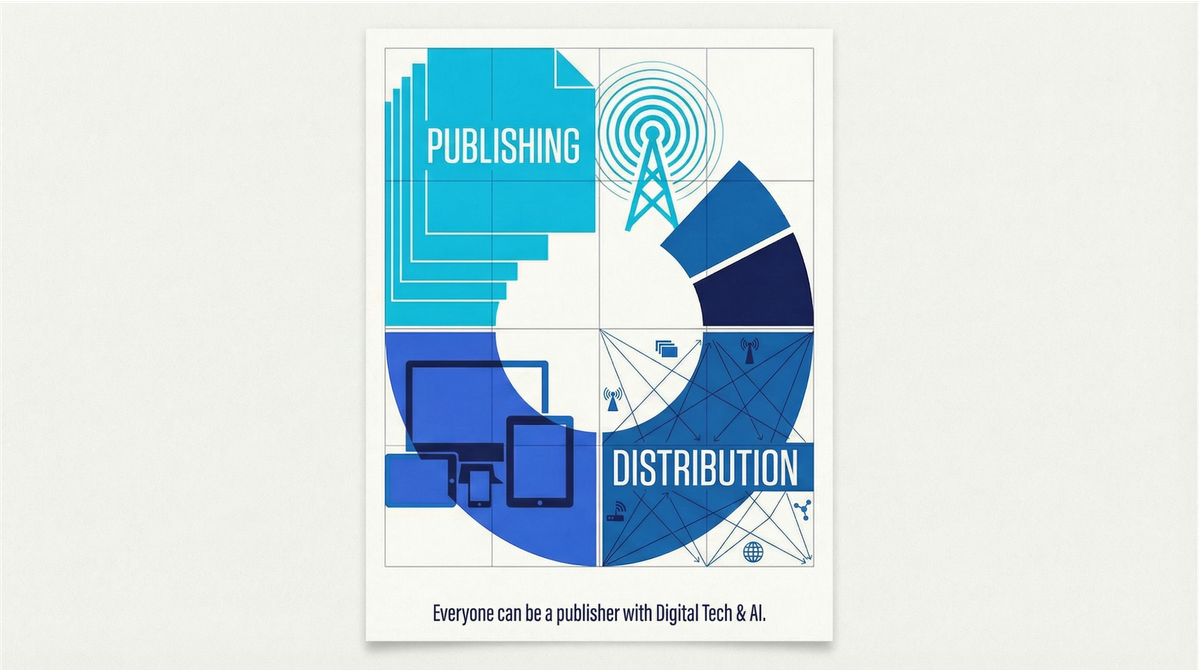
Audiences need to rely on you before they buy from you.
Anyone with a connection can distribute at scale, for free (or very little), to any device—mobile, desktop, or tablet. You are no longer just a creator; you are a broadcaster. You are a publisher.

But this democratization brings a new challenge. When everyone has a megaphone, how do you get heard?
Publishing is not just about hitting "post." It is about strategic amplification. It is understanding that the same core message must wear different clothes depending on where it goes.
A LinkedIn post is not a billboard. A podcast is not a flyer.
In this edition, we explore the 4 Formats of Content and the Channels to distribute that content to get to your audience.
The Foundation: Consistency Over Frequency
Before we discuss formats, we must address the most common publishing mistake: the obsession with frequency.
Algorithms love frequency, but humans love consistency.
You do not need to post every hour to build an audience. You need to show up when you say you will. Whether it is a daily tweet, a weekly newsletter, or a monthly report, the cadence matters less than the reliability.
Audiences need to rely on you to buy from you.
Trust is built on expectation. If your audience knows they can count on your insight every Tuesday morning, you become part of their routine. That routine builds the trust required for a transaction.
The Strategic Matrix: Formats vs. Channels
Before diving into the details, use this matrix to orient your strategy. A "Channel" is where the content lives; a "Format" is the shape it takes.
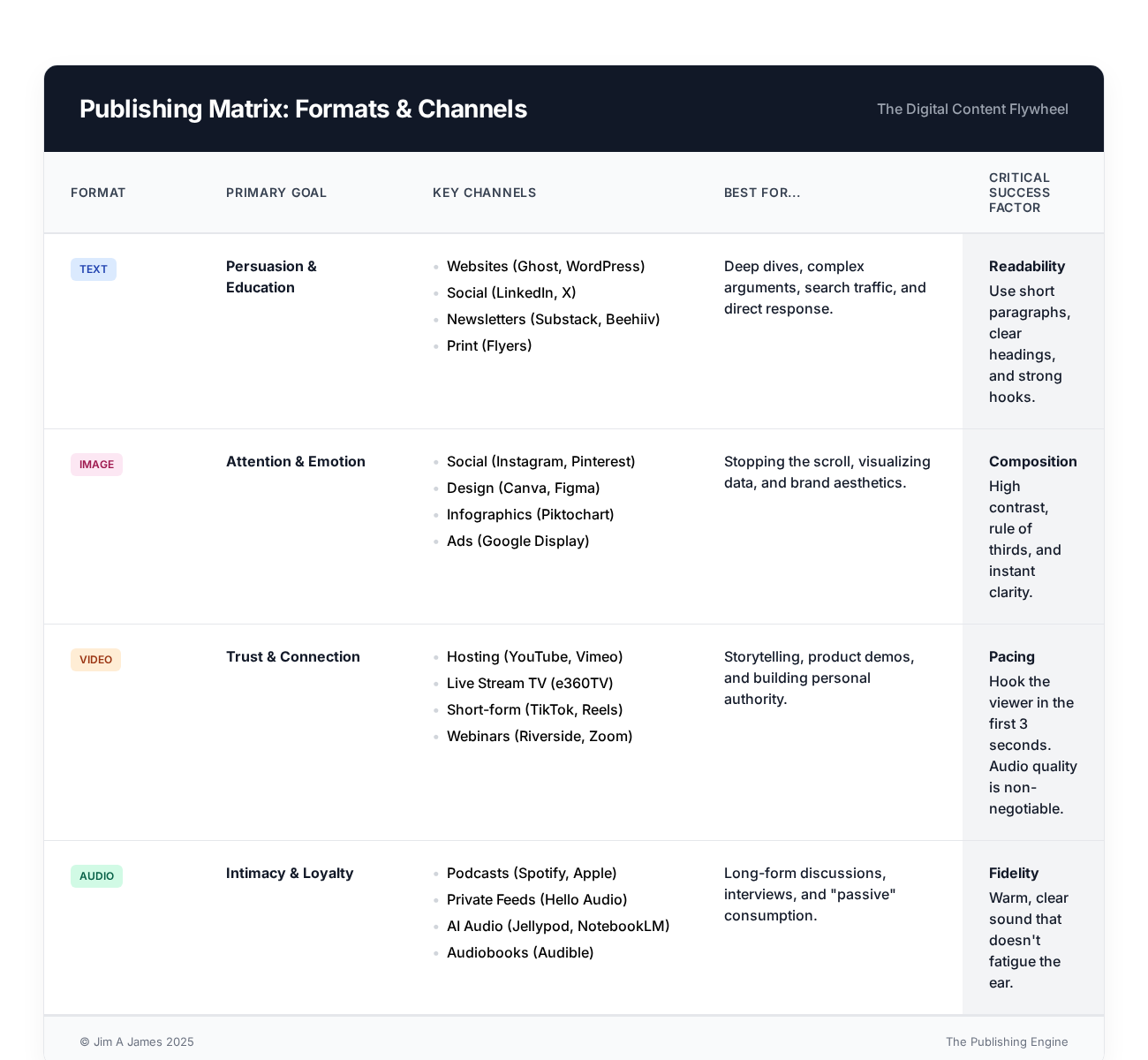
1. Text: The Architecture of Thought
Text is the most versatile and durable format. Its primary power lies in Persuasion and Education.
It is the vehicle for complex ideas, detailed arguments, and storytelling that requires the reader's active engagement. While search engines love text, its true purpose is to change minds and transfer knowledge.
Characteristics & Nuances
- Typography: On screens, sans-serif fonts (like Inter or Helvetica) rule for readability. In print, serifs (like Times New Roman) guide the eye along the line.
- Layout: Digital text demands "breathing room"—short paragraphs, generous line height, and bullet points to break the "wall of text." Print allows for denser columns and justified alignment.
- Quantity: The internet has infinite shelf space, but limited attention spans. Long-form wins on blogs (1,500+ words) for SEO; short-form wins on social (<280 characters) for engagement.
Channel Strategy
- Websites & Blogs: The "home base." This is owned media. Use it for evergreen content that solves specific problems.
- Social (LinkedIn, X/Twitter, Reddit): The "town square." Use text here for hot takes, threads, and starting conversations. The goal is engagement, not just broadcast.
- Medium / Substack: The "magazine." Use for thought leadership and building a direct subscriber relationship.
- Print (Flyers, Sign Boards): The "interruption." Use for local awareness. A flyer must communicate value in 0.5 seconds.
When to use: When you need to convey complex information, improve searchability, or control the narrative in detail.
2. Image: The Visual Hook
The brain processes images 60,000 times faster than text. In a scrolling world, the image is the stop sign. It creates the emotional context before a single word is read.
Characteristics & Nuances
- Composition: The "Rule of Thirds" applies everywhere. Don't center everything. Create dynamic tension.
- Color: Use high contrast for mobile screens. Your brand palette should be instantly recognizable even without a logo.
- Resolution: A pixelated image is a trust-killer. Always aim for 2x density (Retina) for digital.
- Context: An Instagram image is square (1:1) or vertical (4:5). A YouTube thumbnail is horizontal (16:9). One size does not fit all.
Channel Strategy
- Instagram & Pinterest: The "gallery." Aesthetic is everything here. It's not just about the info; it's about the vibe and aspiration.
- Billboards & Posters: The "shout." You have 3 seconds. One dominant image, five words max.
- Infographics: The "teacher." Condense a 1,000-word article into one shareable graphic. These are link-magnets.
- Thumbnails: The "ad." Its only job is to get the click. High emotion, high contrast faces work best.
When to use: To grab attention, evoke emotion quickly, or simplify complex data.
3. Video: The Trust Accelerator
Video is the closest proxy to being in the room with someone. It captures tone, body language, and personality in a way text never can. It is the most powerful tool for building trust at scale.
Characteristics & Nuances
- Pacing: The first 3 seconds are do-or-die. Start with the hook, not the logo intro. Cut out the "umms" and dead air.
- Captions: 85% of social video is watched on mute. Hard-coded subtitles are mandatory, not optional.
- Orientation: Vertical (9:16) for mobile discovery (TikTok, Reels). Horizontal (16:9) for desktop depth (YouTube, TV).
- Lighting & Audio: Bad lighting is forgivable; bad audio is not. If they can't hear you clearly, they scroll.
Channel Strategy
- YouTube: The "library." Searchable, evergreen, long-form. The second largest search engine in the world.
- TikTok / Reels / Shorts: The "feed." Ephemeral, algorithm-driven, discovery-focused. Focus on trends and entertainment.
- TV & Cinema Ads: The "prestige." High production value, broad reach, brand building.
- Webinars: The "classroom." Live interaction, deep engagement, direct sales.
When to use: To demonstrate a product, tell a story, or build a personal connection.
4. Audio: The Intimate Companion
Audio is the only format that can be consumed passively—while driving, cooking, or working out. It invites you into the listener's head. It builds a different kind of relationship: loyalty.
Characteristics & Nuances
- Fidelity: Warmth and clarity matter. A "tinny" voice fatigues the ear. Invest in a decent microphone.
- Structure: Unlike text, you can't "skim" audio. It needs a clear narrative arc to keep the listener from tuning out.
- Intimacy: It feels like a 1:1 conversation, even if thousands are listening. Speak to "one person," not a crowd.
Channel Strategy
- Podcasts: The "series." Deep dives, interviews, niche topics. Great for loyalty and retention.
- AI-Generated Audio: The "synthesizer." Tools like NotebookLM can now instantly convert text into conversational audio, creating new listening opportunities from existing written content.
- Private Podcasts: The "inner circle." Secure feeds for employees, premium subscribers, or community members. Distribution doesn't always mean "public."
- Radio: The "broadcast." Broad reach, local targeting, repetitive frequency.
- Social Audio (Spaces, Clubhouse): The "conference call." Live, interactive, community building.
- Audiobooks: The "legacy." The highest value format for packaging knowledge.
When to use: For deep discussions, interviews, and reaching people during their "downtime."
Conclusion: The Omni-Channel Mindset
You do not need to be everywhere at once. But you do need to understand where your audience lives.
The master publisher takes one core idea (Creation) and translates it into the native language of each platform. The blog post becomes a Twitter thread (Text). The thread becomes a carousel (Image). The carousel becomes a TikTok script (Video). The video audio becomes a podcast clip (Audio).
Choose one format and one channel to start with...master that and then use the model here to expand your content strategy over time.
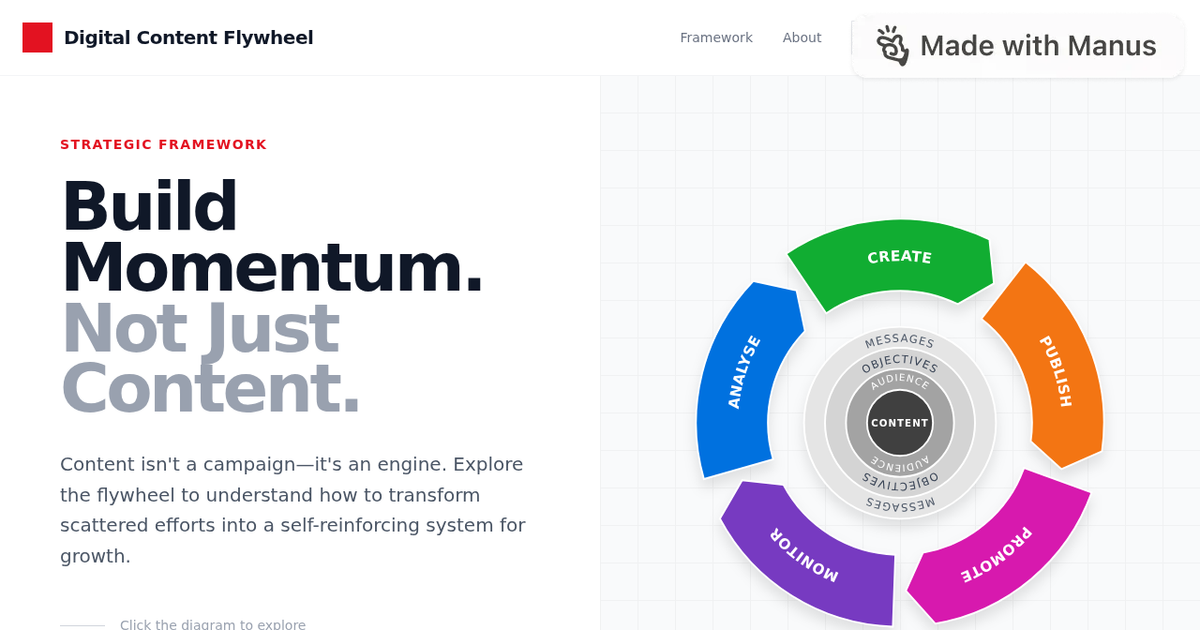
Check out my interactive flywheel and download on the site. Or if you'd like to just talk with me about your strategy, just use the link below.