The Digital Content Flywheel: A Strategic Framework for Entrepreneurs
This framework transforms content from a scattered collection of posts and campaigns into a powerful, self-reinforcing cycle that builds momentum over time.


[⬇️At the end of this article is the document to download too!⬇️]
This framework is as relevant today as when I first developed it for media relations back in the mid 1990's. AI makes a content strategy even more pressing. I developed the Digital Content Flywheel as the Founder and Managing Director of EASTWEST Public Relations, the agency I established the agency in Singapore in 1995 and grew it across China and India before successfully exiting in 2020.
Over those 25 years of helping clients to get noticed, I saw a pattern: successful companies didn't just produce "more" content; they built a self-reinforcing engine.
Content is no longer a nice-to-have—it's the engine that drives business growth. Yet many entrepreneurs misunderstand content strategy because they approach it as a one-time effort rather than a continuous, interconnected system.
This framework transforms content from a scattered collection of posts and campaigns into a powerful, self-reinforcing cycle that builds momentum over time. Whether you're launching a startup, scaling a growing business, or pivoting your market position, understanding how to activate each stage of this flywheel is essential to your success.
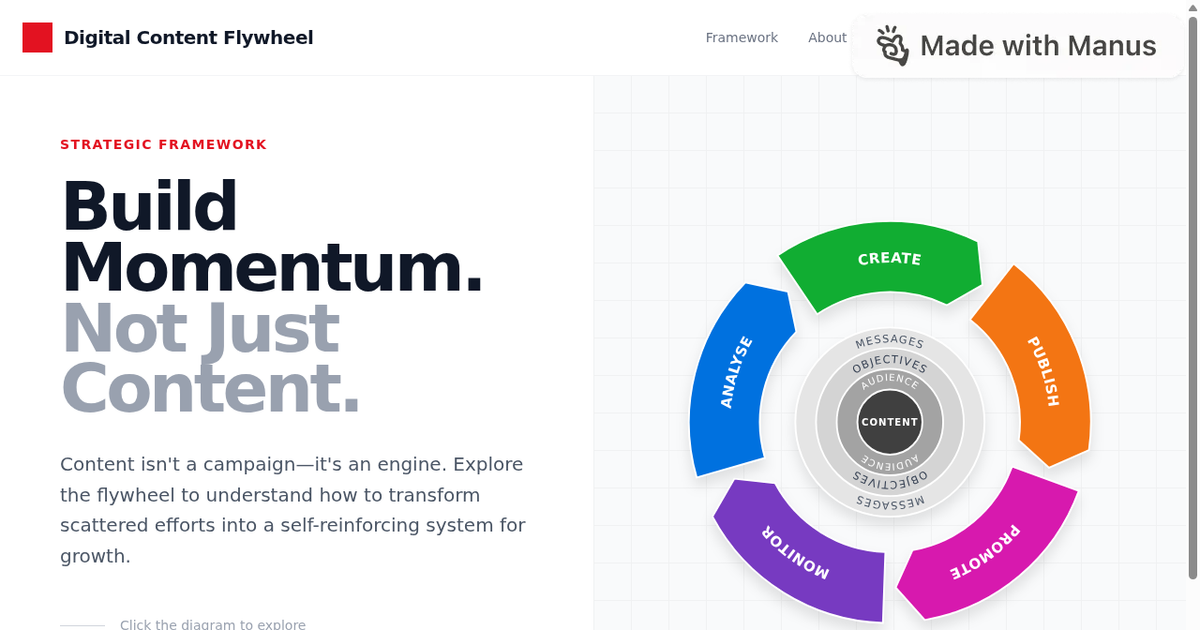
Use this interactive chart to see the different elements:
Read on for more explanation.
Part 1: The Core Foundation
Understanding the Digital Content Flywheel
The Digital Content Flywheel is a strategic model that illustrates how content works best when all its components function together as an integrated system. Rather than treating content creation, distribution, and analysis as separate activities, this framework shows how each element feeds into the next, creating a virtuous cycle that accelerates growth.
The flywheel operates on a fundamental principle: quality content, strategically targeted at the right audience, with clear objectives and consistent measurement, creates momentum that compounds over time.
Why This Matters for Entrepreneurs
As an entrepreneur, your resources are limited. You can't afford to waste time on content that doesn't move the needle. The Digital Content Flywheel ensures that every piece of content you create serves a purpose within a larger strategic ecosystem. It prevents the common trap of creating content for content's sake and instead focuses your efforts on what actually drives business results.
Part 2: The Inner Rings—Your Strategic Foundation
Layer 1: Content (The Core)
Definition: Content is the substance—the ideas, stories, information, and value you share with your audience. It's the foundation upon which everything else is built.
Why It Matters: Without compelling, valuable content, nothing else in the flywheel works. Your content must be relevant, authentic, and aligned with your business goals. It's not just about what you say; it's about why you're saying it and how it serves your audience.
Key Considerations:
- Content should reflect your unique perspective and expertise
- It must solve real problems or answer genuine questions your audience has
- Quality always trumps quantity
- Consistency in voice and messaging builds trust over time
Layer 2: Audience (The Second Ring)
Definition: Your audience is the group of people you're trying to reach and influence. But not all audiences are created equal, and your content strategy must account for these differences.
Segmenting Your Audience:
Entrepreneurs typically need to reach three distinct audience segments, each with different needs and motivations:
Internal Audience: Your team, employees, and stakeholders. These are the people inside your organization who need to understand your vision, strategy, and values. Content for this audience builds culture, alignment, and internal advocacy.
External Audience: This includes potential customers, government agencies, regulators, and other external stakeholders who influence your business environment. They need to understand what you do, why you do it, and how it benefits them. This is where much of your customer acquisition content lives.
Allies: Your customers, referral partners, media outlets, and industry influencers. These are the people who actively champion your business. Content for allies deepens relationships, encourages word-of-mouth marketing, and creates advocates who amplify your message.
Why Segmentation Matters: Different audiences consume content differently and have different information needs. A blog post that resonates with potential customers might confuse your internal team. By clearly defining who you're speaking to, you can tailor your message, tone, and format accordingly.
Layer 3: Objectives (The Third Ring)
Definition: Objectives are the specific outcomes you want to achieve with your content. They answer the question: "What do we want to happen as a result of this content?"
Common Content Objectives:
Engagement: How many people interact with your content? Are they reading, watching, or listening? Engagement metrics include views, clicks, time spent, and initial reactions. High engagement indicates your content resonates.
Discussion: Are people talking about your content? Discussion goes beyond passive consumption—it's when your audience comments, shares their own perspectives, and creates conversations around your ideas. This signals that your content sparked genuine interest.
Participation: Does your audience take action? Participation might mean signing up for a webinar, downloading a resource, attending an event, or joining a community. It's a stronger signal of interest than engagement alone.
Loyalty: Are people coming back? Loyalty is built through consistent, valuable content that keeps your audience returning. It's measured through repeat visits, subscriptions, and long-term engagement patterns.
Why Objectives Matter: Without clear objectives, you can't measure success. You'll create content, publish it, and have no way to know if it's working. By defining what success looks like upfront, you create accountability and can continuously optimize your approach.
Layer 4: Messages (The Outermost Ring)
Definition: Messages are the specific ideas, themes, and talking points you want to communicate. They're the "what you want to say" that supports your objectives.
Crafting Effective Messages:
Your messages should be:
- Clear and specific: Avoid vague statements. "We help businesses grow" is weak. "We help B2B SaaS companies reduce customer acquisition costs by 30% through data-driven content strategy" is strong.
- Audience-focused: Frame your messages around what matters to your audience, not what matters to you.
- Consistent: Use the same core messages across different content pieces and channels to build recognition and recall.
- Supported by evidence: Back up your messages with data, case studies, or examples that prove your claims.
Examples of Strong Messages:
- "Content strategy isn't about posting more—it's about posting smarter"
- "The businesses winning in 2025 are those who treat content as a system, not a campaign"
- "Your audience doesn't want to be sold to; they want to be educated"
Why Messages Matter: Messages are the bridge between your objectives and your content. They ensure that every piece of content you create reinforces your key themes and moves your audience toward your desired outcomes.
Part 3: The Five Stages of the Flywheel
Stage 1: Create
What It Is: The Create stage is where you develop the actual content—the blog posts, videos, podcasts, infographics, case studies, and other assets that embody your messages and serve your audience.
Key Activities:
- Brainstorm content ideas based on audience needs and your key messages
- Develop a content calendar that ensures consistent output
- Create diverse content formats to reach different learning preferences
- Maintain quality standards and brand consistency
- Involve subject matter experts and storytellers in the process
Why It Matters: Creation is where strategy becomes reality. But here's the critical insight: creation without strategy is just busy work. By grounding your creation process in your audience, objectives, and messages, you ensure that every piece of content serves a purpose.
Pro Tip for Entrepreneurs: You don't need to create everything yourself. Consider repurposing content (turning a blog post into a video, a webinar into an article), collaborating with team members, or outsourcing to freelancers. The key is maintaining consistency and quality.
Stage 2: Publish
What It Is: Publishing is getting your content in front of your audience through the right channels at the right time.
Key Activities:
- Choose the right distribution channels for each piece of content
- Optimize content for each platform (LinkedIn posts differ from blog posts)
- Schedule content strategically to maximize reach
- Ensure technical optimization (SEO, mobile-friendly, fast loading)
- Create a publishing rhythm that your audience comes to expect
Why It Matters: Great content that nobody sees is worthless. Publishing is about making sure your content reaches the people who need it. Different audiences consume content on different platforms, so a multi-channel approach is essential.
Platform Considerations:
- LinkedIn: Professional audiences, B2B content, thought leadership
- Blog: Long-form content, SEO benefits, owned audience
- Email: Direct communication, highest engagement rates
- Social Media: Awareness, reach, community building
- Webinars/Podcasts: Deeper engagement, authority building
Stage 3: Promote
What It Is: Promotion is actively amplifying your content beyond its initial publish date to extend its reach and impact.
Key Activities:
- Share content across multiple channels and formats
- Leverage paid advertising to reach new audiences
- Encourage team members and allies to share your content
- Create content series that build on each other
- Use email to promote content to existing subscribers
- Engage with communities and platforms where your audience gathers
Why It Matters: The "set it and forget it" approach to content doesn't work. Promotion ensures that your content gets multiple exposures and reaches people who might have missed it the first time. It also signals to algorithms that your content is valuable, which can improve organic reach.
Promotion Strategy:
- Repurpose content across platforms (blog post → LinkedIn post → email → social clips)
- Create multiple promotional messages highlighting different angles
- Time promotions strategically (not everyone sees content the first time)
- Involve your team and community in amplifying the message
Stage 4: Monitor
What It Is: Monitoring is actively tracking how your content is performing in real-time and how your audience is responding.
Key Activities:
- Track engagement metrics (views, clicks, shares, comments)
- Monitor audience sentiment and feedback
- Identify which content formats and topics resonate most
- Watch for emerging conversations and trends
- Engage with your audience by responding to comments and questions
- Identify opportunities to join relevant conversations
Why It Matters: Monitoring keeps you connected to your audience and helps you understand what's working. It also allows you to respond quickly to feedback, correct misinformation, and capitalize on emerging opportunities. In fast-moving markets, real-time monitoring can be the difference between leading and following.
What to Monitor:
- Engagement rates across different content types
- Audience demographics and behavior
- Sentiment in comments and social mentions
- Competitor activity and industry trends
- Emerging questions or pain points your audience is discussing
Stage 5: Analyse
What It Is: Analysis is the systematic review of your content performance data to extract insights and inform future strategy.
Key Activities:
- Review performance metrics against your objectives
- Identify patterns in what content performs best
- Calculate ROI on content investments
- Assess whether you're achieving your engagement, discussion, participation, and loyalty goals
- Document learnings and insights
- Use data to refine your strategy and content approach
Why It Matters: Analysis transforms raw data into strategic insights. It answers the critical question: "Is our content strategy working?" More importantly, it reveals why certain content works, so you can do more of it.
Key Metrics to Analyze:
- Engagement: Views, time on page, click-through rates
- Discussion: Comments, shares, mentions
- Participation: Sign-ups, downloads, event attendance
- Loyalty: Return visitors, email subscribers, repeat customers
- Business Impact: Leads generated, customers acquired, revenue influenced
Part 4: The Flywheel Effect
How the Stages Connect
The magic of the Digital Content Flywheel happens when you complete the cycle and then repeat it. Here's how it works:
- Create content based on your audience, objectives, and messages
- Publish that content through the right channels
- Promote it to extend its reach and impact
- Monitor how your audience responds and engages
- Analyse the results to understand what worked
- Create better content next time, informed by your analysis
Each cycle builds on the previous one. Your analysis from one round informs your creation in the next. Your audience grows. Your messages get sharper. Your content gets better. The flywheel spins faster.
The Compounding Effect
This is where the real power emerges. After several cycles, you'll notice:
- Your audience grows and becomes more engaged
- Your content gets better because you know what works
- Your team becomes more efficient at content production
- Your message resonates more clearly
- Your business results improve
This is the compounding effect of a well-executed content strategy. It doesn't happen overnight, but it's unstoppable once you get it going.
Part 5: Getting Started with Your Flywheel
Step 1: Define Your Audience
Start by clearly identifying who you're trying to reach. Break them into the three segments: internal, external, and allies. For each segment, ask:
- Who are they?
- What do they care about?
- What problems do they face?
- Where do they consume content?
Step 2: Clarify Your Objectives
What do you want to achieve with content? Are you focused on building awareness (engagement), creating conversation (discussion), driving action (participation), or building long-term relationships (loyalty)? Most businesses need all four, but your emphasis might differ by audience segment.
Step 3: Develop Your Core Messages
What are the 3-5 core ideas you want your audience to understand about your business? These messages should be specific, audience-focused, and supported by evidence.
Step 4: Create Your First Batch of Content
Don't wait for perfection. Create content that reflects your audience, objectives, and messages. Start with formats that play to your strengths. If you're a great speaker, start with video or podcasts. If you're a strong writer, start with blog posts or LinkedIn articles.
Step 5: Publish and Promote Strategically
Get your content in front of your audience. Use multiple channels. Promote multiple times. Don't expect everything to go viral—focus on reaching the right people, not the most people.
Step 6: Monitor and Engage
Pay attention to how your audience responds. Engage with them. Answer questions. Join conversations. This feedback is gold.
Step 7: Analyse and Iterate
After 4-6 weeks, review your data. What worked? What didn't? What did you learn about your audience? Use these insights to refine your approach.
Step 8: Repeat and Accelerate
Now that you've completed one cycle, do it again—but better. Your second cycle will be more efficient and more effective because you've learned from the first.
Conclusion: Your Content Advantage
In a crowded marketplace, content strategy is one of the few sustainable competitive advantages available to entrepreneurs. It's not about having the biggest budget or the fanciest tools. It's about having a clear system that ensures every piece of content serves a strategic purpose.
Your Digital Content Flywheel provides that system. It transforms content from a scattered collection of activities into a coordinated, strategic engine that builds momentum over time.
The businesses that will dominate in the coming years aren't those that create the most content. They're the ones who create the right content, for the right audience, with the right objectives, delivered through the right channels, and continuously optimized based on real data.
That's the power of the Digital Content Flywheel. And now you have the framework to build it.
Next Steps
This overview introduces the framework and its components. In future deep-dives, we'll explore each stage in detail, providing specific tactics, tools, and templates you can use to activate your flywheel. We'll also look at how different business models and industries can customize this framework to their unique needs.
For now, take time to map out your own flywheel. Define your audience. Clarify your objectives. Develop your messages. Then start creating content that brings this framework to life.
I have a dedicated website that you can visit to see the Flywheel and share with anyone that you think should see this too.

Your competitive advantage is waiting on the other side of that first cycle.
If you want help with creating your content strategy, book a call with me using the link below.

You can call me, or even talk with my digital twin to get early advice.